

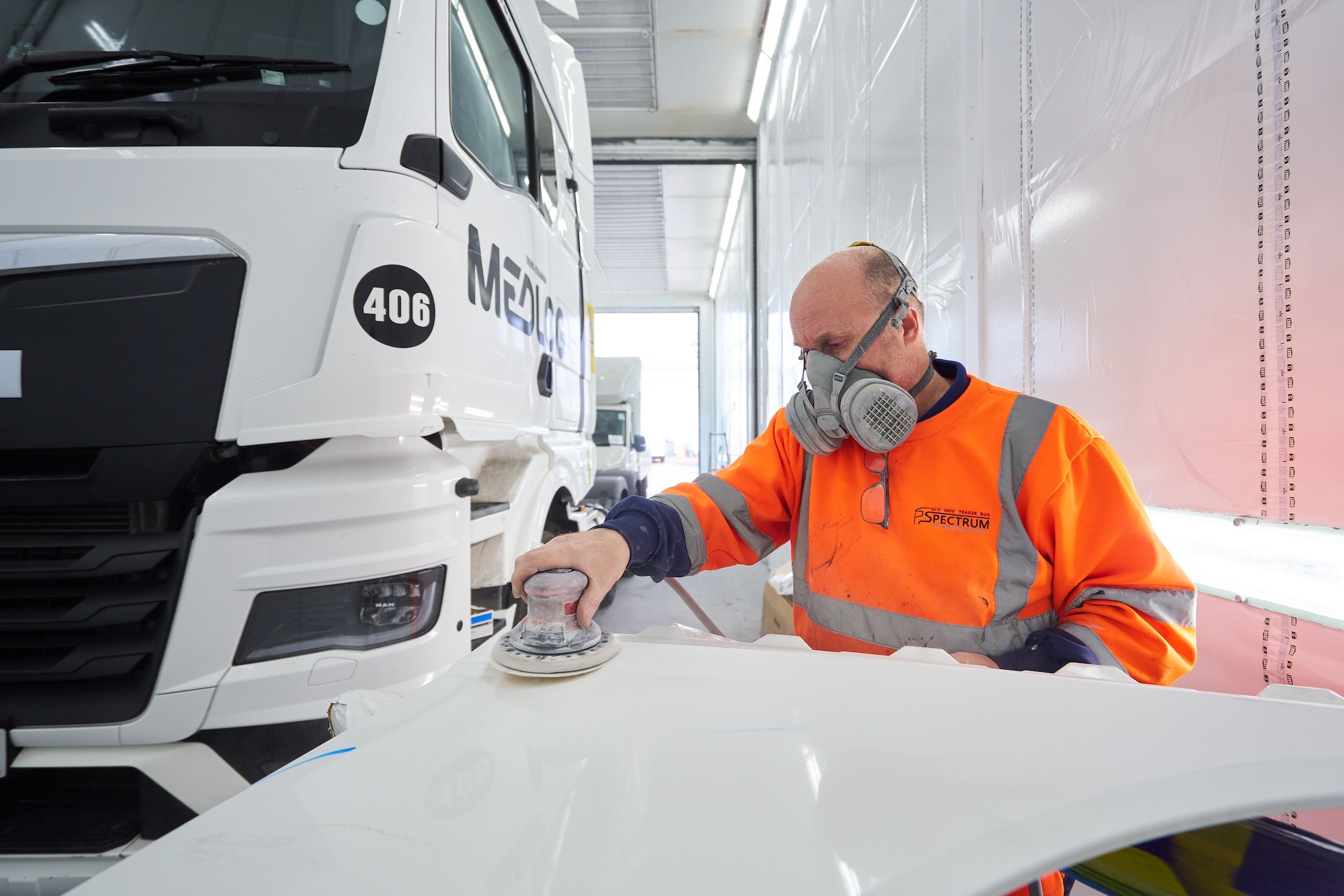
“Commercial vehicle respray” and “fleet livery” often come up together, but they’re not quite the same job. A respray is about the paint itself, colour, coverage and finish. Livery matching is about consistency: making sure every vehicle in a fleet carries the same branding, colours and graphics correctly, whether it’s one van being repaired or twenty trucks being refreshed at once. This guide covers what to expect from paint and refinishing with The Spectrum VR Group.
Paint and refinishing work at The Spectrum VR Group sits alongside our wider HGV repair service, since a respray is often the final stage after structural or panel work, though it’s also carried out on its own where a vehicle just needs a fresh finish.

What’s involved in a commercial vehicle respray
Preparation. Before any paint goes on, panels are cleaned, sanded and masked, and any dents or surface damage are made good first. Skipping or rushing this stage is usually what causes a respray to look uneven once it’s finished, so it’s worth as much attention as the paint itself.
Colour matching. Precision colour-matching is what makes a respray look factory-finished rather than patched. We match to manufacturer-specific finishes and to existing fleet colours, so a repainted panel or a fully resprayed vehicle sits correctly alongside the rest of your fleet.
Booth size and vehicle type. HGVs, buses and coaches need a spray booth long enough and with enough clearance to take the full vehicle in one pass, which is different equipment to what’s needed for a van or car. Our Essex and Kent centres run 18m spray booths built for this scale, covering HGVs and LCVs, buses and coaches, trailers and tippers, and specialist or custom vehicles.
Fleet livery matching, explained
Livery is more than paint colour; it’s the branding, graphics and colour codes that make a fleet instantly recognisable. When one vehicle in a branded fleet needs a repair or respray, the goal is for it to come back looking identical to the rest of the fleet, not just a similar shade.
That means working from your fleet’s specific colour codes and livery design rather than a generic colour match, and applying the same standard whether it’s a single vehicle being touched up or several vehicles being refreshed together. Consistency across a fleet is what makes the branding read correctly from a distance, on the motorway or in a car park, which is often the point of having a livery in the first place.
Full respray or a blended repair?
Not every job needs a full respray. A localised repair, blending new paint into the surrounding panel, can sometimes be enough for a scrape or a single damaged panel, and it’s quicker and less costly than repainting the whole vehicle. A full respray makes more sense when damage is spread across multiple panels, when the existing paint has degraded evenly across the vehicle, or when a fleet is rebranding and every vehicle needs to match a new livery.
Our team can assess which approach fits during the initial inspection, so you’re not paying for a full respray when a blended repair would do the job just as well.
See our post on 40 years of commercial vehicle repair and painting for more on how our paint and refinishing work has developed. For repairs that follow an accident specifically, our guide to what happens after a commercial vehicle accident covers the process from assessment through to the final respray.
Can you match an exact fleet colour code, or just a close match?
We work from your fleet’s specific colour codes and manufacturer-specific finishes wherever these are available, aiming for an exact match rather than an approximation. If you have a Paintspec, colour reference or manufacturer code, providing it at the assessment stage speeds this up.
Do you handle livery and graphics, or just the paint?
Our refinishing service covers the paint and colour-matching side of livery. Get in touch with details of your existing livery design so we can confirm exactly what’s needed to bring a vehicle back in line with the rest of your fleet.
How long does a full commercial vehicle respray take?
It depends on vehicle size and the condition of the existing paintwork, but preparation is usually the longest stage. A blended repair on a single panel is typically much quicker than a full respray across an HGV or bus.
We can give an accurate timeline once the vehicle has been assessed.
Can you respray a whole fleet at once, or does each vehicle need booking separately?
We can coordinate resprays across multiple fleet vehicles, scheduling them so operations aren’t disrupted all at once. Get in touch to discuss fleet size and timing, and we can put together a plan that works around your schedule.